The Faroe Islands are built for self-drive travel, and renting a car is the best way to explore them. Most islands link together through bridges, tunnels, and well-signed main roads, so you can move between landscapes quickly without needing a boat.
Many rural roads are still narrow or gravel, and some routes use passing places, small, widened areas. You will also want to plan around fast-changing Atlantic conditions, because the weather can shift between fog, sun, wind, and rain in minutes. Our guide focuses on quiet villages in the Faroe Islands, highlighting harbour-side detail and small-scale local character.
Village driving is a different skill from highway driving: you will use narrow lanes, shared spaces, and small car parks, so you must park carefully and leave room for locals and farm traffic.
Stop one is Gjógv, one of the most photogenic villages in the Faroe Islands, because its identity is literally carved by water. The village is named after its 200-metre sea-filled gorge, and this natural harbour gives you that rare combination of geology and village life in one frame.
For views, you come for the coastline and stay for the walking. Gjógv is also linked with attractive walking routes, including the classic Funningur-to-Gjógv hike, which covers roughly 4 kilometres and usually takes about 1 hour and 20 minutes. The route includes cairns on higher ground.
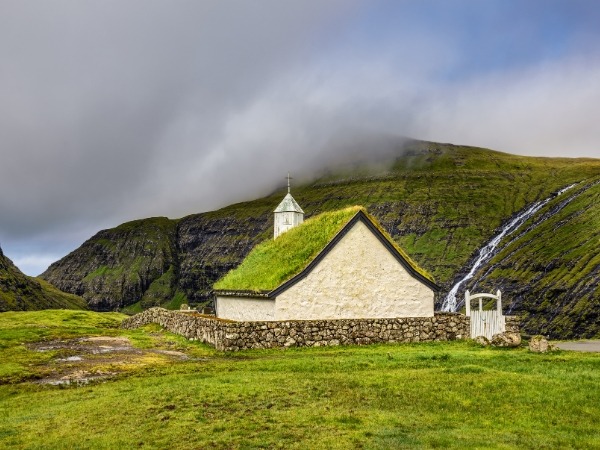
Saksun is the stop you choose when you want the Faroe Islands to feel quiet and wide. It sits in a natural amphitheatre above a tidal lagoon, so the village appears like a balcony over water, grass, and mountains. The classic image here is traditional turf roofs against a huge green bowl of land.
Photography is strong in almost any weather because the place holds the mood so well. Mist softens it, sunlight sharpens it, and low cloud can make the lagoon appear almost mirrored. If you want that calm feeling at its best, arrive early, walk slowly, and let the place's pace set the rhythm for your stop rather than the other way round.
At low tide, you can walk along the sandy shore of the lagoon around the headland. Saksun also includes a church dating back to 1858 and Dúvugarðar, an active sheep farm that serves as a museum.
Tjørnuvík has a dark beach, steep mountains, and an open Atlantic horizon. From the shore, you can see Risin and Kellingin, the famous sea stacks tied to local legend, so the setting carries a sense of myth without requiring a demanding hike.
It is also one of the best places to see modern outdoor culture in a village setting. Tjørnuvík is known for surfing, which makes sense once you see how the bay faces the open sea. There is a contrast here between the old settlement history and the present-day rhythm of the beach, the waves, and the changing weather.
The area includes Viking graves in the valley, and excavations in the 20th century revealed a burial with a well-preserved skeleton and a Viking sword.
Kirkjubøur is one of the best villages in the Faroe Islands if you want history. It is a short drive from the capital, so it fits easily into a self-drive day without planning or a long detour.
This stop is famous for condensing national history into a very small space. Roykstovan, a farmhouse and museum with around 900 years of history, stands alongside Ólavskirkja, built in 1111, and the medieval Magnus Cathedral from the 1300s. Roykstovan is the oldest wooden house still in use. The same family has lived there for generations, which gives the village a sense of living heritage.
Bøur is small, but the view is big. From here, you get one of the most memorable outlooks in the Faroes: a view across the sea towards Tindhólmur, the rocky islet with its five castle-like peaks.
For many travellers, the main reason Bøur appears on lists of the best villages to visit in the Faroe Islands is its potential as a lookout. From Bøur, you can frame Tindhólmur beautifully. You can use it as a viewpoint towards Drangarnir, the famous sea stacks between Vágar and Tindhólmur.
Bøur also links neatly with nearby villages. There is an old postman route between Bøur and Gásadalur, so if the weather looks friendly, you can combine a short drive with a classic footpath.
Gásadalur is one of the most iconic villages in the Faroe Islands, and the one you have probably already seen in photographs. It is home to the Múlafossur waterfall, where water cascades down to the ocean.
To reach it, you drive through the tunnel, park, and then walk a short distance to reach the viewpoint, which is part of what makes the stop feel so satisfying. For sunrise and sunsets, go to the west. Gásadalur is on the western side of Vágar, and the viewpoint also offers a strong view of Mykines on clear days.
Funningur is an ancient settlement at the foot of Slættaratindur, surrounded by tall mountains. It is the highest mountain in the Faroe Islands at 880 metres. It is one of the most scenic villages in the Faroe Islands, with colourful houses set in a narrow valley beside the river Stórá.
The cultural anchor here is the church. Funningur’s church is one of the remaining artistic wooden churches from the period between 1829 and 1847, and its tarred walls, white windows, white tower, and turf roof give it a distinctive warmth even on grey days. The present church dates from 1847 and is part of a long local sequence of churches built on the same site.
Viðareiði gives you the “edge of the map” feeling, even though you arrive on paved roads. Bird cliffs to the north and powerful sea conditions helped make it the historical centre of the Northern Islands.
Villingardalsfjall, the third-highest mountain in the Faroe Islands at 844 metres, rises over the village, while Malinsfjall stands on the other side. The result is a deep bowl of steep mountains, sea exposure, and serious visual scale. Hikes here can be rewarding because even short distances can quickly produce height and broad views.
To get here, most road trippers use the Northern Islands transport corridor, including the sub-sea tunnel system that connects this part of the Faroes with the rest of the network.
The best Faroe Islands road trip is not the one where you try to beat the clock. It is the one where you drive within the limits and carefully. If you do that, you can fully explore wind shifting, clouds lifting, and villages appearing quietly at the end of a fjord road.
Rent a car in the Faroe Islands with Final Rentals to explore every quiet village and scenic road with ease. Select your pickup location, enter your travel dates, and choose a vehicle for your trip. Book and manage your car rental at any time. Download the Final Rentals app on Google Play and the App Store.
Usually, you do not. Major roads are paved, even though some smaller village roads can be gravel. The real priorities are tyre quality, visibility, caution, weather awareness, and your confidence behind the wheel. A compact car is often the better choice because it is easier to manage on narrow roads, in small parking areas, and in villages with tight turns.
You drive through tunnels in the Faroe Islands without stopping, and your number plate is registered automatically. You then pay online within a few days, so keep your vehicle details ready and confirm in advance whether your rental company charges the tolls directly or expects you to pay them yourself.
For most travellers, May to September is the best time to visit the Faroe Islands because you get longer daylight, greener scenery, and easier access for outdoor plans and village hopping. That said, conditions can still shift quickly, so bring layers, keep your schedule flexible, and expect changing weather.